The fourth quarter capped another strong year for investors, extending gains across global equity markets and reinforcing the resilience of risk assets despite elevated valuations and persistent macroeconomic uncertainty. For the quarter, the S&P 500 rose 2.7%, developed international markets gained 4.9%, and emerging markets advanced 4.7%. Fixed income also posted positive returns of 1.1%, as yields declined modestly at the short end of the curve while remaining relatively stable further out.
Looking at the full year, 2025 delivered solid but uneven results across asset classes. U.S. equities finished the year up 17.9%, while developed international markets gained 31.2% and emerging markets rose 33.6%, marking one of the strongest relative years for non-U.S. equities in over a decade. Bonds generated positive total returns of 7.3%, supported by income and a gradual shift toward easier monetary policy.
Credit spreads across both investment-grade and high-yield markets remain relatively tight, reflecting optimism around economic stability and corporate earnings. These conditions suggest markets are pricing in favorable outcomes, leaving limited margin for disappointment.
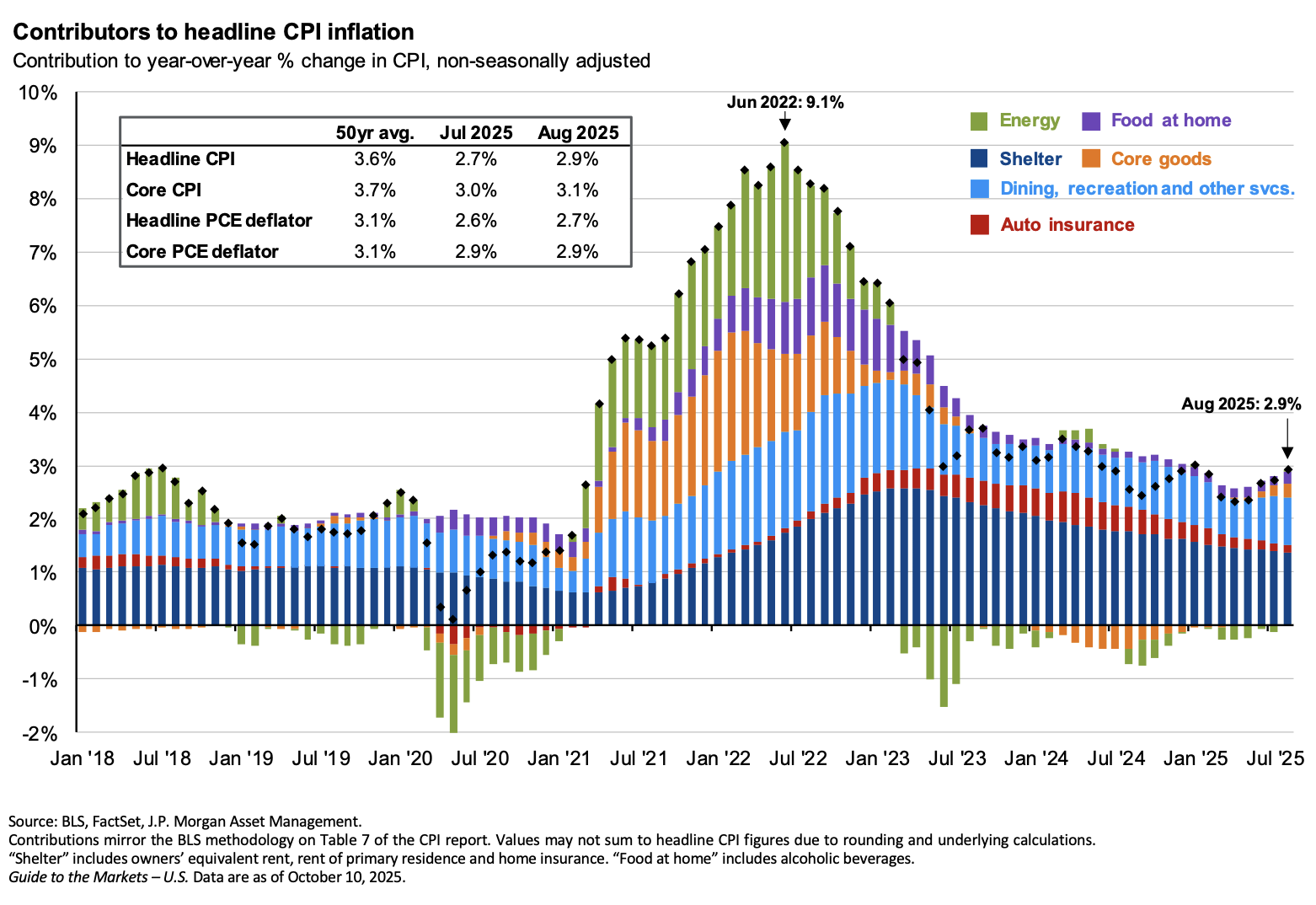
The Federal Reserve began easing monetary policy in the second half of the year, initiating a measured series of rate cuts as conditions evolved. While economic growth remained positive, labor conditions softened, providing the Fed with flexibility. Inflation continued to moderate in 2025, though progress slowed as the year progressed. Markets now anticipate further easing in 2026, with short-term rates declining more quickly than longer-dated yields.
Beneath the headline numbers, the internal dynamics of capital markets remain important to understand.
Entering 2025, one of the most notable themes was the outsized influence of the media-branded Magnificent Seven companies within the S&P 500. These dominant U.S. technology firms accounted for approximately 46% of the index’s 1-year price return and 55% of the cumulative return over the past three years. During that time, these companies benefited from strong competitive positions, attractive returns on invested capital, and substantial free cash flow generation.

Source: FactSet, Standard & Poor’s, J.P. Morgan Asset Management. Magnificent 7 (Mag 7) includes AAPL, AMZN, GOOGL/GOOG, META, MSFT, NVDA and TSLA. The S&P 500 ex-Mag 7 (S&P 493) is calculated by backing out a weighted average Mag 7 price return from the S&P 500 price return. *Share of returns represents the Mag 7’s contribution to the index return. Past performance is no guarantee of future results. Guide to the Markets – U.S. Data are as of December 31, 2025.
At the same time, performance within this cohort has been less uniform than headline index returns suggest. Despite contributing a significant share of the S&P 500’s performance in 2025, only two of the Magnificent Seven outperformed the index on an individual basis, highlighting how concentrated leadership can coexist with meaningful dispersion beneath the surface.
Market concentration has increased amid rising enthusiasm around artificial intelligence and the infrastructure required to support it. In 2025, the Magnificent Seven collectively spent approximately $400 billion on capital expenditures, much of it directed toward AI-related compute, data centers, and supporting infrastructure. Estimates suggest cumulative investment could reach $3 to $4 trillion over the next five years as the buildout continues.
As capital investment increases at an unprecedented pace, expectations for future returns rise alongside it. Sustaining earnings growth will increasingly depend on whether this wave of spending translates into durable economic value.
Much of this investment has flowed toward advanced semiconductors and data-center infrastructure, benefiting companies most directly exposed to AI compute demand. One clear beneficiary has been Nvidia, which has played a central role in supplying the hardware underpinning this investment cycle.
The scale of recent market appreciation underscores how strongly expectations have been capitalized into prices. Nvidia became the first company to surpass both $4 trillion (July 9, 2025) and $5 trillion (October 29, 2025) market capitalization in a single year, moving from the former to the latter in less than four months. A $1 trillion change in market value is roughly equivalent to the entire market capitalization of Berkshire Hathaway, currently the eleventh-largest publicly traded company in the world.
Over recent years, price growth among the Magnificent Seven companies has generally outpaced underlying earnings, leaving valuations elevated relative to the broader market. While this imbalance has persisted, market history suggests such divergences tend to normalize over time rather than extend indefinitely. Today, the ten largest companies in the S&P 500 represent approximately 40% of the index’s total market capitalization, an unusually high level of concentration by historical standards. As a result, elevated valuations among a narrow group of large-cap growth companies have pulled the overall index Price to Earnings Ratio higher, with the S&P 500 ending 2025 trading near 22 times forward earnings.

Source: FactSet, Standard & Poor’s, J.P. Morgan Asset Management. Forward P/E ratio is the most recent price divided by consensus estimates for earnings in the next 12 months, provided by IBES since January 1996 and FactSet since January 2022. The remaining stocks represent the rest of the 490 companies in the S&P 500, and their P/E ratio is calculated by backing out the nominal earnings and market cap of the top 10 from that of the S&P 500. Guide to the Markets – U.S. Data are as of December 31, 2025.
Historically, periods when the index has traded at similar valuation levels have been associated with more muted long-term returns. Forward ten-year returns have tended to be range-bound, reflecting the reality that higher starting valuations often compress future returns even when underlying businesses continue to perform well.
That dynamic does not imply an absence of innovation or economic progress, but rather highlights how markets price future expectations.
Periods of rapid market appreciation can emerge in different ways. At times, they are driven by speculation, where prices move well ahead of fundamentals and ultimately revert. At other times, enthusiasm is tied to meaningful shifts in productivity, infrastructure, or business models that reshape how the economy functions. In those environments, valuations can still overshoot in the short term even as the underlying innovation delivers lasting benefits.
Artificial intelligence today reflects elements of both dynamics. The narrative is compelling: AI has the potential to transform industries, improve efficiency, and reshape how work is done. Capital is flowing in rapidly, with both large technology companies and newer entrants investing heavily in models, data centers, and AI-driven applications. At the same time, speculation has become rampant in certain corners of the market, with enthusiasm in some cases moving well ahead of established fundamentals.
Periods of rapid innovation can blur the distinction between a good product and a good investment.
Revolutions are essential to the betterment of society. Major advances such as railroads, electricity, and the internet were accompanied by periods of exuberant investment and uneven outcomes for investors. While these periods ultimately left the world better off, economic progress did not translate evenly into investment returns. Many projects failed, capital was often deployed inefficiently, and a significant share of investors experienced permanent losses despite transformative change. The market’s role in funding innovation is rarely linear or orderly, but it often accelerates in ways that prove durable.
Strong periods of performance can also influence investor behavior. When leadership becomes highly concentrated and recent winners dominate headlines, the temptation to chase what has already worked tends to increase.
Against this backdrop, today’s market reflects both genuine innovation and elevated expectations. The challenge for investors is not to dismiss technological progress, but to distinguish durable advances from excess enthusiasm and to balance long-term opportunity with valuation awareness and risk management.
This distinction reinforces the importance of diversification and selectivity. Concentrated exposure to the most popular segments of the market may perform well for extended periods, but it also increases vulnerability if expectations change. A disciplined approach emphasizes owning businesses with durable cash flows, strong balance sheets, and the ability to benefit from innovation without relying solely on optimistic assumptions or leverage.
This perspective helps frame our ownership of Berkshire Hathaway, which gained 10.9% in 2025.
Fundamentally, Berkshire remains on solid footing. Operating earnings continue to show trend growth, underwriting discipline within the insurance operations remains intact, and the balance sheet ended the year with significant strength, including approximately $381 billion in cash reserves as of September 30, 2025. That liquidity reflects a deliberate choice to preserve flexibility rather than pursue fully valued opportunities, even if that patience weighs on short-term relative performance.
The company also entered a new chapter at year-end with the retirement of Warren Buffett. Warren’s legacy, investment acumen, and long-term track record are unmatched. Over roughly six decades of stewardship, Berkshire delivered compounded annual returns of more than 19%, significantly outpacing the S&P 500’s long-term average.
That long-term record also reflects resilience relative to the broader market. Over the past sixty years, the S&P 500 finished the year lower on 13 occasions, and Berkshire outperformed the benchmark in eleven of those years.
While this transition is meaningful, we view it as one of continuity rather than change. We have strong confidence in Warren’s successor, Greg Abel, who has been deeply involved in Berkshire’s operating businesses and capital allocation decisions for many years. The firm’s decentralized structure, conservative financial profile, and long-standing culture of disciplined capital deployment were intentionally designed to endure beyond any single individual.
Greg understands the principles that have long guided Berkshire’s capital allocation, and we believe the company’s disciplined, long-term orientation is well positioned to endure.
As we close out 2025 and look ahead to 2026, our approach remains consistent. We continue to trim positions where valuations appear stretched, lean into areas where risk-adjusted returns are more compelling, and maintain diversified exposure across asset classes. Periods of volatility are not reasons to retreat, but opportunities to rebalance and strengthen portfolios.
Our guidance remains straightforward: stay diversified, stay disciplined, and stay focused on the long term. Portfolios grounded in quality and balance are best positioned to weather uncertainty and benefit from the opportunities that follow.
Please reach out if you would like to review your portfolio or financial plan as we begin the new year. We are grateful for your trust and confidence.
Respectfully,
The JRM Investment Counsel Team
Jack, Phil and Lauren