Happy New Year to Our Clients and Friends,
As we step into 2025, we reflect on another remarkable year for the U.S. stock market. For those broadly invested in U.S. equities, 2024 provided plenty to celebrate. The S&P 500 posted an impressive 25% return, building on the 26% gain recorded in 2023.
We’ve heard comparisons between the “Roaring 20s” of the 1920s and this decade. Both included recovery from a worldwide pandemic, a strong economy and record highs in the stock market. For context, the Dow Jones Industrial Average increased sixfold from 63 in 1921 to 381 in 1929, before the historic crash of the Great Depression. Today, the Dow is over 42,000, reflecting the astounding wealth creation by capital markets over the past century.
Focusing on the present, the S&P 500 has delivered over 14% annualized returns (96% cumulative) during the first five years of the 2020s, despite two bear markets. The following chart highlights intra-year drawdowns alongside calendar year returns—a reminder that even strong long-term results often come with significant market volatility.

It’s hard to believe that just five years ago, the world was grappling with the COVID pandemic and a 34% drawdown of the S&P 500 index … and only two years ago, inflation soared past 8% causing the Fed to initiate the most aggressive hiking cycle in modern history. Investors faced a rare and challenging scenario with simultaneous bear markets in both stocks and bonds during 2022.
The index’s two consecutive years in 2023-24 of 25%+ returns is uncommon, having occurred only three other instances in nearly a century—1935-36, 1954-55, and 1997-98. It’s worth noting that strong years in the market often come in clusters.

So how did the market perform in the year following these uncommon returns? The sample size is small, and the outcomes ranged from another year of extraordinary gains to significant declines. Of the three instances where consecutive market returns exceeded 25%, the third year results were:
- 1937: Down 35%
- 1956: Up 7%
- 1999: Up 21%
These results emphasize the inherent unpredictability of markets and the importance of a long term mindset for equity investors.
Today’s optimism around U.S. equities stems from several factors: a strong economy, expectations for lower corporate income taxes and interest rates, reduced regulation, and the transformative potential of artificial intelligence.
As shown in the chart below, by nearly every standardized measure of valuation, the S&P 500 index is expensive.

The S&P 500’s Forward P/E ratio at year-end was 21.5x, significantly above its 30-year average of 17x. As shown in the following charts, there is a clear inverse relationship between the Forward P/E ratio and longer-term forward returns. Lower valuations and shorter time periods tend to exhibit greater dispersion in results, highlighting the limited usefulness of valuations for predicting short-term performance. However, over the long term, as shown in the 5-yr chart, valuations play a more critical role in asset allocation decisions.

Valuations have historically explained only 7% of return variability (as measured by R-squared) over one-year periods, emphasizing the difficulty of predicting short-term market movements. In the next 12 months, markets could grow more expensive, valuations might align with earnings growth, or a correction could bring prices closer to historical averages. Simply put, near-term market outcomes are highly uncertain.
Given this unpredictability, we do not engage in market timing strategies. Valuations are not reliable when forecasting short-term returns, as demonstrated by the chart of one-year outcomes. Outcomes at current valuations ranged from declines exceeding 20% to gains over 40% looking out twelve months.
The takeaway from the five-year chart is clear. Starting valuations matter over the long term and as valuations move higher, we have tempered expectations for forward returns. While no one can predict when or if a correction will occur in 2025, history offers perspective. Since 1980, intra-year drawdowns have averaged 14% annually, yet calendar returns were positive in 34 out of 45 years. Without a crystal ball, unnecessarily interrupting compounding due to elevated valuations can prove to be a costly decision.
Intermediate-term bond yields rose sharply in the past year. The chart below illustrates the Treasury yield curve at the start and end of 2024. Notably, there is an inflection point near the two-year maturity: yields on bonds under two years have declined by approximately 1%, while yields on longer-term bonds have increased by a similar margin.

The inverse relationship between interest rates and bond prices dampened returns for the Bloomberg Aggregate Bond Index in 2024. Despite rising rates on the long end of the curve, the index managed to deliver a modest 1.25% return for the year.
With bond yields now offering attractive income, they should provide meaningful diversification to portfolios, especially given the elevated valuations in domestic equities. If the U.S. equity market does decline, bonds should act as a ballast in globally diversified portfolios.
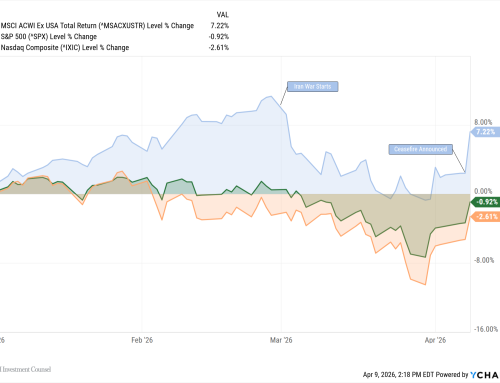
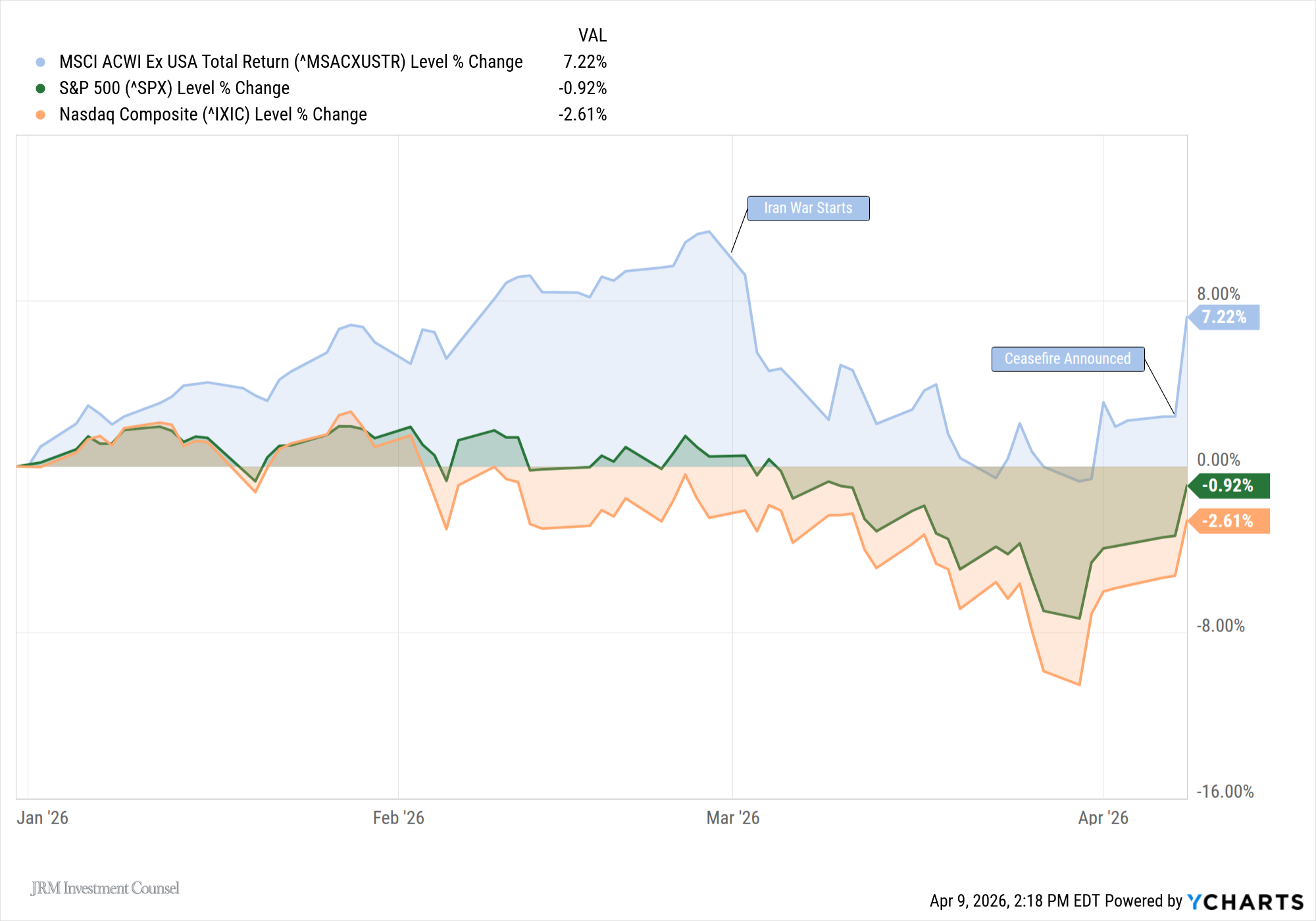
International equities posted positive returns last year, with the MSCI ACWI Ex-USA gaining 5.5%, though they once again underperformed domestic equities. Stocks abroad continue to trade at a historic discount to U.S. markets. Over the past decade, international stocks have delivered annualized returns that trail U.S. equities by 7%. This performance gap understandably raises questions about the value of international exposure in portfolios.

Stock returns are naturally volatile, and even a decade is a relatively short timeframe within the broader context of market cycles. While U.S. stocks have enjoyed a period of dominance since the Financial Crisis of 2008, sentiment can shift unexpectedly.
Back-to-back years of strong U.S. market performance reinforces the importance of staying invested. If challenges arise or equity valuations come under pressure, diversification can play a crucial role in managing portfolio risk.
We are grateful for your trust and confidence, and further wish you a healthy and prosperous 2025. Please let us know if you have questions, would like to discuss your financial plan or review your investment portfolio in the new year.
Respectfully,
The JRM Investment Counsel Team
Jack, Phil and Lauren