Following a strong finish to 2024, markets entered the new year with continued momentum. The S&P 500 advanced steadily through January, reaching a record high on February 19.
That early momentum faded as the quarter progressed. Markets grew increasingly unsettled by rising geopolitical tensions and speculation around a return to more protectionist US trade policies. Comments from President Trump regarding potential new tariffs, combined with broader global uncertainty, began to weigh on investor sentiment.
From its peak in mid-February, the S&P 500 declined roughly 8%, finishing the quarter down 4.3%. Despite the market pullback, the economic backdrop remained strong, supported by a resilient labor market and steady consumer demand. Bond yields moved higher as expectations for near-term rate cuts diminished. Developed and emerging market stocks fared better, with foreign equities returning 6.9% and 2.9%, respectively, for the quarter.
Then—on April 2nd—President Trump issued an Executive Order declaring a national emergency aimed at reshaping global trade relationships. The order included a sweeping set of tariff increases, marking the most significant escalation in trade barriers in over a century.
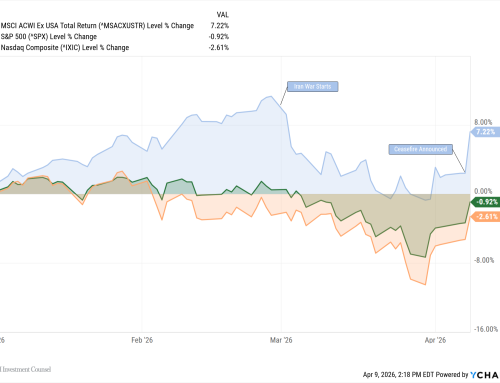
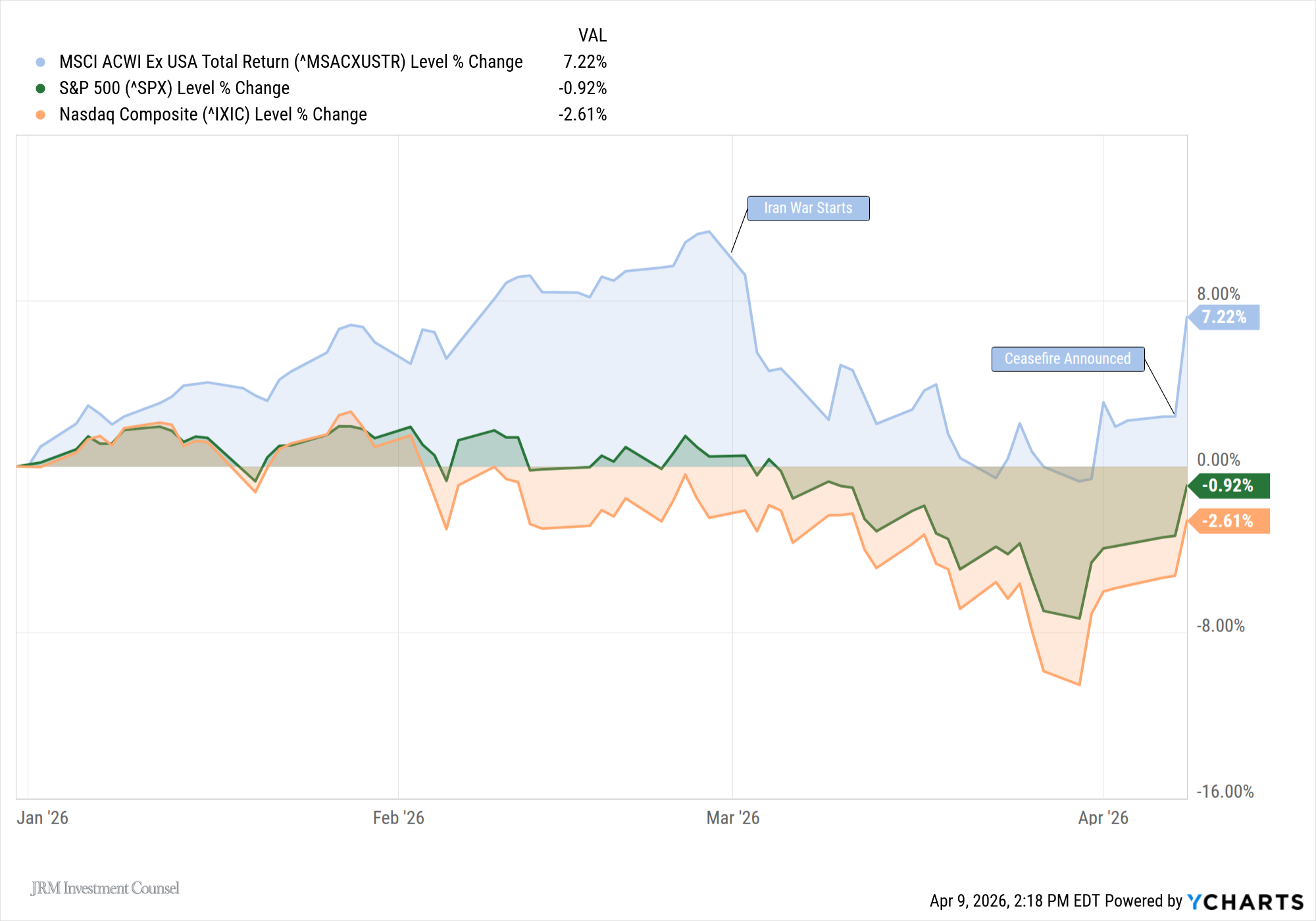
The announcement triggered a wave of volatility and increased the perceived risk of a near-term global recession. Investors reacted swiftly to the prospects of retaliatory trade measures, supply chain disruptions, and the potential for higher inflation amid softening economic growth. The S&P 500 dropped 11% over two trading days, erasing approximately $6 trillion in market value.
The selloff extended beyond US markets, with global equities also declining in tandem—reflecting rising fears of a broader global economic slowdown. In fixed income, Treasury yields fell sharply, as investors moved into safer assets and began pricing in a higher probability of rate cuts by the Federal Reserve later this year.
So what are these new tariffs, and what do they mean for investors?
The broad structure of the new tariff regime is:
- Most US trading partners will be subject to a minimum 10% tariff.
- Countries labeled as “bad actors” will face “reciprocal tariffs” designed to offset imbalances created by both formal and informal trade barriers—such as currency manipulation or subsidies.
- USMCA trade agreement between the US, Mexico and Canada will largely remain exempt from these new tariffs, except for auto exports, steel and aluminum, which fall under separate tariff policies.
According to The Office of the US Trade Representative (USTR) who advised Trump on the order, “Reciprocal tariffs are calculated as the tariff rate necessary to balance bilateral trade deficits between the US and each of our trading partners. This calculation assumes that persistent trade deficits are due to a combination of tariff and non-tariff factors that prevent trade from balancing. Tariffs work through direct reductions of imports.”
Rather than addressing specific tariff disparities or non-tariff barriers, the USTR adopted a simplified formula focused on bilateral trade imbalances. The tariff rate is calculated by dividing the US trade deficit with a given country by the total value of imports from that country, then applying roughly half of that percentage as the new tariff. Notably, this approach excludes US services exports—an increasingly important part of our trade balance—resulting in a potentially skewed picture of overall trade dynamics.
Let’s use Vietnam as an example:
- In 2024, the US ran a $123.5 billion trade deficit with Vietnam, while importing $136.6 billion in goods.
- $123.5B ÷ $136.6B = 90.4%.
- The Trump administration imposed a reciprocal tariff of 46% on Vietnamese imports. Previously, Vietnam’s trade weighted tariff was 5.1%, and the US’s tariff was 2.2%.
Vietnam saw a significant rise in capital investment from US companies—such as Nike and Lululemon—that began shifting production out of China during Trump’s first term. The chart below highlights the growing trade imbalance and illustrates the broader relocation of supply chain operations to Vietnam.

Vietnam’s population is 100 million and 2023 GDP per person reached an all time high of $3,760. Exports of goods and services accounted for 87% of its GDP. Vietnam is a poor country relative to the US (US GDP per person is $80,706) and cannot afford to import enough goods from the US to close the trade imbalance.
What’s especially striking is that Vietnam proactively reduced its tariffs on US goods including cars, liquified gas and some agricultural products prior to the tariff announcement, hoping they would be treated favorably under the new policy.
Tariffs are taxes on goods entering the US and are initially paid by the importing company—not the exporting country. Over time, the economic impact often shifts. Importers may raise prices to offset costs, effectively passing the burden to US consumers or downstream businesses. In other cases, they may reduce or delay orders for goods that become too expensive to justify, creating ripple effects across both domestic and global supply chains.
The Trump administration believes trade deficits weaken the US economy and that a lack of domestic manufacturing poses a national security risk. There are valid reasons to support rebuilding certain strategic industries within our borders—particularly those tied to defense, infrastructure, and critical technology. That said, these are long-term goals that take time to achieve, and they are unlikely to be addressed meaningfully by the time the new “reciprocal” tariffs take effect on April 9.
If you want to read direct from the source about their thesis, a fact sheet was published by the administration and is accessible at this link:
In the six days since Trump’s announcement, economists have been publicly discussing the potential pros and cons of the tariff policy. So far, virtually every major financial institution and research group has expressed concern.
From J.P. Morgan… The tariffs amounted to a tax increase equal to 2.4% of US gross domestic product, on par with the 1968 tax hike, which equaled 2.6% of GDP. And the tariff rates were even higher than the Smoot-Hawley Tariffs, widely seen as making the Great Depression truly great.
From Wells Fargo… At the heart of tariffs lies an effort to increase prices to achieve various policy objectives (e.g., greater domestic production, negotiating leverage, tax revenues). The tariffs announced on April 2 are set to do that in spades. Our macroeconomic model shows the roughly 20 percentage point jump in the effective tariff rate will boost the year-over year rate of headline PCE inflation 1.8 percentage points above the baseline forecast. Looking at core PCE inflation the effect is even larger. The model points to the core PCE deflator rising 2.3 percentage points above the baseline forecast in Q2-2025.
From Apollo…Downside risks to the economy are intensifying, with consumer and corporate confidence deteriorating, negative impact of tariffs on earnings and GDP, negative impact of retaliation, negative impact of a $6 trillion decline in the S&P 500 and DOGE layoffs of federal employees.
From the Tax Foundation…
- The imposed tariffs will reduce after-tax incomes by 1.9 percent on average, with the top 1 percent of taxpayers seeing a smaller 1.6 percent reduction in after-tax incomes. Per US household, the imposed tariffs will amount to an average tax increase of more than $1,900 in 2025.
- We estimate the average tariff rate on all imports will rise from 2.5 percent in 2024 to 16.5 percent—the highest average rate since 1937—under the Trump tariffs announced for 2025. We estimate tariffs would cause imports to fall by slightly more than $800 billion in 2025, or 25 percent.
- The tariffs are larger than the tax increases enacted under Presidents George H.W. Bush, Bill Clinton, and Barack Obama.
- We estimate that before accounting for any foreign retaliation, Trump’s tariffs will reduce US GDP by 0.7 percent. The tariffs announced April 2 drive most of that effect, reducing US GDP by 0.4 percent. Threatened and imposed retaliatory tariffs affect $330 billion of US exports based on 2024 US import values; if fully imposed, we estimate they would reduce US GDP by 0.1 percent. Combined, the US-imposed tariffs and the threatened and imposed retaliatory tariffs reduce US GDP by 0.8 percent.
From Fed Chair Jerome Powell…You have inflation that’s going to be moving up, and growth is going to be slowing. It’s not clear at this time what the appropriate path of monetary policy will be.
From the American Enterprise Institute… If implemented, the tariffs announced yesterday by President Trump would constitute the largest tax increase since the 1968 levies to fund the Vietnam War. The details will matter, but my back-of-the-envelope calculation suggests that the tariffs — which are taxes on imported goods — could be as large as 2 percent of annual GDP. This tax increase would be larger than the expiring 2017 tax cuts that Trump is trying to extend.
And last, from Barron’s magazine… Trump Alone Can End Tariff Pain.
So where do we go from here?
President Trump has sent mixed signals about the potential for country-by-country negotiations. Historically, he has taken a confrontational approach early on, often with the intent of creating leverage for negotiating deals. He’s shown a willingness to disrupt and break things with an underlying intent to resolve the disruption and save the day.
This approach worked well in the past when we were negotiating with a few countries. However, this time the economic risks are amplified by our behavior towards friend and foe alike and the potential coalition of the rest of the world against the US. If that occurs, negotiating bi-lateral agreements with each of our trading partners on favorable terms will become more difficult.
The administration may carve out exemptions for certain US companies manufacturing abroad…particularly those that commit to re-shoring operations or that previously shifted production away from China in response to the 2018 trade policies.
We believe incentivizing US manufacturing, particularly in sectors tied to national security, is sound domestic policy. That said, the Trump administration’s approach appears overly broad and abrupt, potentially underestimating the ripple effects. Global trade and geopolitics are highly complex and interdependent, making the outcomes of such actions inherently difficult to predict.
There is a lot we don’t know about how this will play out. Investors are becoming increasingly risk-averse, equities are declining and bonds are rallying. What’s particularly notable, is that the US dollar has not been a source of safety, and instead of strengthening, is weakening against most major currencies. As shown below, although the dollar index has recovered slightly, it initially fell 7% from January levels.

This may be a sign that global investors are re-evaluating their view of the US. For decades, a large share of the world’s capital has been parked in US markets, not just because of our economy’s size and potential for growth, return, and liquidity, but also due to its reputation for safety, stability, and institutional credibility.
Tariffs don’t just pose a short-term drag on growth…they also have the potential to alter how international investors view the long-term attractiveness of US assets. In this context, the Federal Reserve’s response could play a pivotal role in evolving investor sentiment.
The Federal Reserve faces a familiar but difficult balancing act. Tariffs are inherently inflationary, yet also pose a risk to growth and employment. A tariff-driven slowdown could prompt rate cuts to support the economy—but doing so could also boost inflation, particularly if consumer demand remains firm.
Given the recent memory of surging inflation during the pandemic, we believe the Fed is likely to prioritize price stability over employment. As a result, they may be cautious about cutting rates in the near term. This view differs from that of the interest rate futures market, which is currently pricing in four rate cuts in 2025, beginning in June.
While the long-term implications are still unfolding, the near-term takeaway is clear: policy uncertainty has once again become a major driver of market volatility.
Every economic shock is different, and economists have an inconsistent track record when it comes to accurately predicting how such events will play out. Elements of the Trump economic agenda—such as proposed tax cuts or regulatory easing—may help offset some of the negative effects of the tariffs, but the net impact remains uncertain.
As illustrated in the chart below, the US economy and stock market have demonstrated remarkable resilience—navigating through decades of disruption, including wars, multiple recessions, pandemics, and other major crises.

Long-term outcomes are driven by the power of compounding and the discipline to stay invested through market cycles. Over the past 35 years, investors who stayed the course were well rewarded—earning annualized S&P 500 returns of over 10% and a cumulative gain of more than 2,900%.
Periods of uncertainty and market volatility are an inevitable part of investing—and we understand how unsettling they can feel in the moment. That’s why diversification and a thoughtful financial plan are so essential.
Historically, the US stock market experiences a 10% correction nearly every year, and declines of 20% or more every few years. More severe drawdowns—over 30%—have happened seven times since 1940.
These drawdowns can’t be predicted or avoided, but they can be planned for. With a diversified portfolio and a thoughtful financial plan, investors can endure volatility and stay on course for long-term success. We’re here to help you navigate these moments with perspective and confidence.
If you’d like to review your financial plan or investment portfolio, we’d be happy to connect. Please don’t hesitate to reach out.
Respectfully,
The JRM Investment Counsel Team
Jack, Phil and Lauren